
This section is created for everyone who is interested, but especially for beginners who have those typical early doubts. For any other questions, we are available through the designated communication channels.
1- Which airbrushes to buy?
The usual question when starting out is Which airbrushes can I use? The answer itself lies in another question: what are you going to use it for? Just like a bicycle, to give an example, with a mountain bike you can ride on the road and with a road bike, if you don’t push it, you can take a ride in the mountains, but is it the most appropriate choice? Obviously not; you will never achieve optimal performance on either vehicle, and in the case of the road bike, it will end up damaged and make you lose motivation.
In the case of airbrushing it is exactly the same; using the wrong or unsuitable equipment leads to frustration and discouragement, even giving up entirely.
Most of the time, we fall into the belief that buying a low-cost airbrush is the best way to start, but the truth is that this is not entirely true. In these cases, what we discussed in the previous paragraph applies just the same; there are many types and models of budget airbrushes, and you have to know how to choose.
Select your airbrushes according to your needs. If you are going to use water-based paints that require thinning and you don’t have enough experience, look for wide nozzle sizes, from 0.35 or 0.5 onwards, to prevent the airbrush from clogging constantly—for example, paints for textiles and decoration.
If you are going to use solvent-based paints, make sure your airbrush can withstand them. Nowadays almost all of them do, but budget ones are more vulnerable; care must be taken so that the solvent product does not reach the seals/O-rings.
If your compressor is small or has a low capacity, use a gravity-feed airbrush; these models consume slightly less air and will allow you to work comfortably.
If your only goal is to spray, look for single-action airbrushes. There are fewer and fewer left; these work like a spray can, with the ability to adjust the stroke, but not while painting—only during pauses.
Our recommendation:
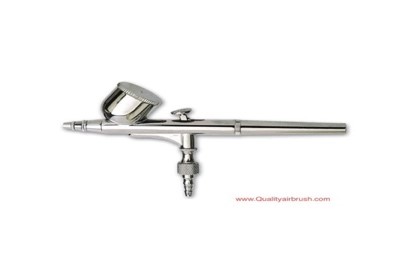
Don’t fall into the trap of the cheapest option. Obviously, don’t buy the best one on the market either, because you won’t take full advantage of it if you are just starting out. Our recommendation is that if you are a beginner, look for a gravity-feed airbrush with a nozzle size of 0.3 or higher, and a floating nozzle, which is easier to clean and prevents breakages (if it is threaded, make sure it is a wide type like the Paasche Talon).
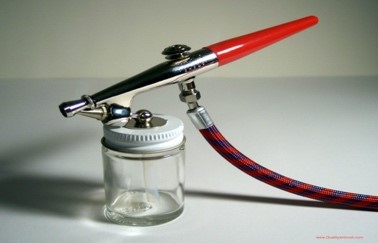
If you have a good compressor, are doing textile work or murals, and are going to use large amounts of paint, use a suction/siphon feed. They usually have wider nozzle sizes, but you will need a compressor powerful enough to handle the work.
Buy budget airbrushes and use them as backups, or failing that, consult us and we will tell you if any of the cheaper options fit your needs.
2 – Which compressor to use?
Another frequently asked question refers to the compressor. In this case, our recommendation is direct and simple: it should have an air tank and be silent or semi-silent.
The first point mentioned, the air tank or reservoir, will give you an advantage when working. The compressor won’t be running constantly; instead, it will only run when the tank runs out of air, which gives us greater working autonomy.
Compressors that do not have an air tank get very hot. These are indicated for short work sessions or small pieces. You must always keep in mind that if we overwork them, they can burn out or break.
Example of a diaphragm compressor.
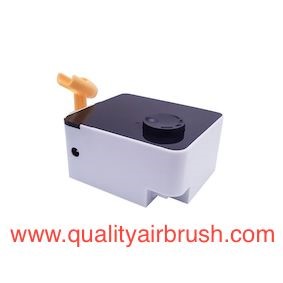
A silent or semi-silent compressor is essential to be able to work at home or in a studio. In the past, there weren’t many alternatives and a silent compressor was always a guarantee of quality but came with a high price tag. This rule hasn’t changed; they remain the best option, the best guarantee of clean air, low noise (15/20dB), long lifespan, and low maintenance. However, today we have more alternatives: we have compressors with 30dB of noise pollution that are perfectly valid for use in closed spaces with guarantees.
Example of a silent compressor with an air tank and pressure regulator/air filter.
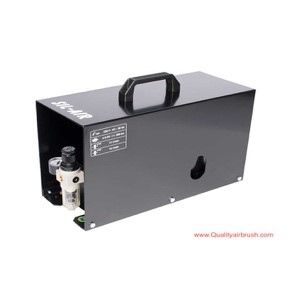
Example of a semi-silent compressor with the same characteristics.
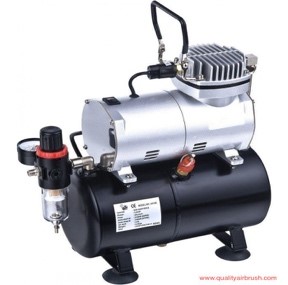
Our recommendation:
In this case, if you are absolutely sure that airbrushing is for you, make a good investment: acquire a good silent airbrush compressor with a tank of 10L or more, a pressure regulator gauge, and a moisture filter. A little specific oil for lubrication will be enough for a long time; they have a practically guaranteed lifespan of over 10 years.
If, on the other hand, you are looking for something to paint occasionally or don’t have that much budget, acquire a semi-silent compressor with the same characteristics; they are perfectly valid and the noise is tolerable.
Avoid industrial compressors at home. In the best-case scenario, they will have 60 decibels; these are meant for workshops and painting with spray guns or airbrushes.
Similarly, even though top brands manufacture them and they have a continuous airflow, avoid diaphragm compressors if you can. They will work great for small things, it’s true, but you will never be able to step outside of that margin.
3- Which paint to use?
Paint is a whole world of possibilities. Out of all those possibilities regarding airbrushes, we could focus on 2 groups: water-based paints and solvent-based paints, although as we have already said, it is a world of possibilities.
There are several differences between these 2 groups:
Solvent-based: ultra-fast drying, excellent adhesion, perfect for masking with guarantees, color vibrancy, excellent and fast evaporation (depending on the quality of the paint). But if we had to highlight something negative, it is clearly the toxicity; a mask is needed to paint, and it is not recommended at home.
Water-based: a wide variety of options available (illustration, textiles, modeling, etc.). The great advantage is non-toxicity; they do not give off an odor. However, if you are going to have long painting sessions, using a mask is also recommended, because even though it does not irritate the mucous membranes, it can cause discomfort. The dilution of these paints depends on the manufacturer, although today there are many that do not require it. As a rule, they have their reducer and percentage already formulated on the label; do not confuse being told they are “ready to use” paints with them already being pre-diluted—you have to check the specifications.
Water-based paints have improved a lot in recent years in terms of adhesion, gloss, resistance, and variety; they are the preferred choice for the vast majority of artists.
Our recommendation:
The choices are varied but well-defined. If you are going to paint at home and do not have extraction ventilation, rule out solvent-based paint—use water-based paint and try to have the piece primed in a workshop if necessary. If you do it at home, the air will be unbreathable. Select a paint that does not require dilution and offers several types of opacities (transparent/opaque); these combos are not expensive and will give you many possibilities without clogging the airbrush, giving you speed and fluidity so you can experiment with them without spending a large amount of money.
If you have to do a custom job or automotive work and you have a workshop, extraction, or ventilation, with solvent-based paint you will move faster, masking tapes will hold with more reliability, and you will save time.
If you want to know more about this, if you are passionate about this world, want to improve your technique, or learn the basics for any discipline—be it modeling, custom painting, realism, textiles, murals, baking, illustration, basic techniques, or textures—get in touch with us and we will inform you about the possibilities of our airbrushing courses.